World Big Air Force
The
United States Air Force (
USAF) is the aerial warfare, space warfare, and cyberwarfare service branch of the United States armed forces and one of the American uniformed services. Initially part of the United States Army, the USAF was formed as a separate branch of the military on September 18, 1947 under the National Security Act of 1947.
[1] It is the most recent branch of the U.S. military to be formed. In its 2010
Posture Statement, the USAF articulates its core functions as Nuclear Deterrence Operations, Special Operations, Air Superiority, Global Integrated ISR, Space Superiority, Command and Control, Cyberspace Superiority, Personnel Recovery, Global Precision Attack, Building Partnerships, Rapid Global Mobility and Agile Combat Support.
[3]
As of 2009
[update] the USAF operates 5,573 manned aircraft in service (3,990 USAF; 1,213 Air National Guardd; and 370 Air Force Reserve);
[4] approximately 180 unmanned combat air vehicles, 2,130 air-launched cruise missiles,
[5] and 450 intercontinental ballistic missiles. The USAF has 330,159 personnel on active duty, 68,872 in the Selected and Individual Ready Reserves, and 94,753 in the Air National Guard as of September 2008. In addition, the USAF employs 151,360 civilian personnel,
[6] and has 57,000 auxiliary members in the Civil Air Patrol.
[7]
The Department of the Air Force is headed by the civilian Secretary of the Air Force who oversees all administrative and policy affairs. The Department of the Air Force is a division of the Department of Defense, headed by the Secretary of Defense. The highest ranking military officer in the Department of the Air Force is the Chief of Staff of the Air Force.
World Big Air Force
Contents
- 1 Mission
- 1.1 Search and rescue
- 1.2 Air sovereignty
- 1.3 Irregular warfare
- 1.4 Airlift
- 2 History
- 2.1 Recent history
- 2.2 Conflicts
- 2.3 Humanitarian operations
- 3 Organization
- 3.1 Administrative organization
- 3.2 Force structure (Major Commands)
- 3.3 Operational organization
- 3.4 Aerospace Expeditionary Task Force
- 3.5 Commander, Air Force Forces
- 3.5.1 Air Operations Center
- 3.6 Air Expeditionary Wings/Groups/Squadrons
- 4 Personnel
- 4.1 Commissioned officers
- 4.2 Warrant officers
- 4.3 Enlisted airmen
- 4.4 Uniforms
- 4.5 Awards and badges
- 4.6 Training
- 4.6.1 Air Force Fitness Test
- 5 Aircraft inventory
- 5.1 A - Ground attack
- 5.2 B - Bombers
- 5.3 C - Cargo transport
- 5.4 E - Special electronic missions
- 5.5 F - Fighters
- 5.6 H - Search and rescue
- 5.7 K - Tanker
- 5.8 M - Multi-mission
- 5.8.1 Multi-mission RPAs (Remote Piloted Aircraft)
- 5.9 O - Observation
- 5.10 R - Reconnaissance
- 5.11 T - Trainer
- 5.12 U - Utility
- 5.13 V - VIP staff transport
- 5.14 W - Weather reconnaissance
- 5.15 Undesignated foreign aircraft used by Special Operations Squadrons
- 6 Culture
- 7 See also
- 8 References
- 9 External links
Mission
According to the National Security Act of 1947 (61 Stat. 502), which created the USAF:
- In general the United States Air Force shall include aviation forces both combat and service not otherwise assigned. It shall be organized, trained, and equipped primarily for prompt and sustained offensive and defensive air operations. The Air Force shall be responsible for the preparation of the air forces necessary for the effective prosecution of war except as otherwise assigned and, in accordance with integrated joint mobilization plans, for the expansion of the peacetime components of the Air Force to meet the needs of war.
§8062 of Title 10 US Code defines the purpose of the USAF as:
[9]
- to preserve the peace and security, and provide for the defense, of the United States, the Territories, Commonwealths, and possessions, and any areas occupied by the United States;
- to support national policy;
- to implement national objectives;
- to overcome any nations responsible for aggressive acts that imperil the peace and security of the United States.
The stated mission of the USAF today is to "fly, fight, and win in air, space, and cyberspace".
[10]
Search and rescue
See also: United States Air Force Rescue Coordination Center
The National Search and Rescue Plan designates the United States Coast Guard as the federal agency responsible for
maritime search-and-rescue (SAR) operations, and the USAF as responsible for aeronautical SAR in the continental U.S. with the exception of Alaska.
[11] Both agencies maintain Joint Rescue Coordination Centers to coordinate this effort.
[12] To help the USAF with the vast number of search and rescue operations, the USAF assigns units of the Civil Air Patrol — the official U.S. Air Force Auxiliary — in over 60% of inland search and rescue missions.
Air sovereignty
The USAF, through the Air National Guard, is the lead agency to maintain control of America's airspace.
On July 30, 2009, Lt. Gen. Harry Wyatt, director of the Air National Guard said that "Technologies needed for the mission include an active, electronically scanned array radar (which can be used to detect small and stealthy air threats including cruise missiles), infrared search and track systems and beyond-line-of-sight communications".
[13]
On September 14, 2009, Gen. Norton A. Schwartz, chief of staff of the USAF, said that he hopes "to bring a combination of F-22, F-35, legacy aircraft, including upgraded F-15 and F-16 fighters, and unmanned aircraft to the [air sovereignty alert] ASA mission."
[14]
Even so, the USAF plans to retire up to 80% of their total force air sovereignty mission aircraft, which would leave no viable aircraft at 18 current air sovereignty sites after 2015.
[15][16][17] The GAO found that 17 of the 20 commanders of the ASA units "stated that the Air Force treats ASA operations as a temporary mission and has not provided sufficient resources."
[18]
The USAF has decided to accept "moderate risk" for the air sovereignty mission as well as deep strike and close air support, under optimistic assumptions for F-35 production.
[19]
The Defense Department has used USN and USMC aircraft for the Air Sovereignty Mission and may do so in the future.
[15]
Irregular warfare
In response to the conflicts in which the United States has been engaged since the end of the Cold War, on August 1, 2007, Air Force Doctrine Document 2-3 was released showing how air power could be used to support or defeat an insurgency.
[20]
To support these missions, the USAF considered outfitting a counter-insurgency wing with small, ground attack aircraft that can also be used for training USAF and allied pilots in addition to counterinsurgency operations.
[21] However the 2010 QDR shifted the future light fixed-wing aircraft to the Air Force’s 6th Special Operations Squadron to be used to train allied forces.
[22]
Airlift
The USAF provides both strategic and tactical airlift in support of wartime, peacetime, and humanitarian efforts of the Department of Defense.
The GAO found that Air Force plans should cover strategic airlift, but that it may fall short in providing tactical airlift in support of the United States Army.
[23]
History
Main article: History of the United States Air Force
The Army created the first antecedent of the USAF in 1907, which through a succession of changes of organization, titles, and missions advanced toward eventual separation 40 years later. The USAF became a separate military service on September 18, 1947, with the implementation of the National Security Act of 1947.
[24] The Act created the United States Department of Defense, which was composed of three subordinate departments, namely the Department of the Army, the Department of the Navy and a newly-created Department of the Air Force.
[25] Prior to 1947, the responsibility for military aviation was shared between the Army (for land-based operations), the Navy (for sea-based operations from aircraft carriers and amphibious aircraft), and the Marine Corps (for close air support of infantry operations).

The predecessor organizations of today's USAF are:

- Aeronautical Division, U.S. Signal Corps (August 1, 1907 to July 18, 1914)
- Aviation Section, U.S. Signal Corps (July 18, 1914 to May 20, 1918)
- Division of Military Aeronautics (May 20, 1918 to May 24, 1918)
- U.S. Army Air Service (May 24, 1918 to July 2, 1926)
- U.S. Army Air Corps (July 2, 1926 to June 20, 1941) and
- U.S. Army Air Forces (June 20, 1941 to September 17, 1947)
Recent history
Since 2005, the USAF has placed a strong focus on the improvement of Basic Military Training (BMT). While the intense training has become, not only longer, it also has shifted to include a deployment phase. This deployment phase, now called the BEAST, places the trainees in a surreal environment that they may experience once they deploy. While the trainees do tackle the massive obstacle courses along with the BEAST, the other portions include defending and protecting their base of operations, forming a structure of leadership, directing search and recovery, and basic self aid buddy care. During this event, the Military Training Instructors (MTI) act as mentors and enemy forces in a very strenuous deployment exercise. In the entirety of BMT, trainees will experience a rigorous 8.5 week training course designed to not only instill discipline, but to mold and shape the trainees around the core values that make every Airman who they are. While in BMT, you can expect sleep deprivation, minimal time for food, physical training, more physical training, and some of the most experienced, disiciplined, strict, sharp and loud instructors the military has to offer. The United States Air Force BMT is now widely considered one of the tougher Bootcamps of the four Military branches.
In 2007, the USAF undertook a reduction-in-force. Because of budget constraints, the USAF planned to reduce the service's size from 360,000 active duty personnel to 316,000.
[26] The size of the active-duty force in 2007 was roughly 64% of that of the USAF at the end of the Gulf War in 1991.
[27] However, the reduction was ended at approximately 330,000 personnel in 2008 to meet mission requirements.
[26] These same constraints have seen a sharp reduction in flight hours for crew training since 2005
[28] and the Deputy Chief of Staff for Manpower and Personnel directing Airmen's Time Assessments.
[29]
On June 5, 2008, Secretary of Defense Robert M. Gates, accepted the resignations of both the Secretary of the Air Force, Michael W. Wynne, and the Chief of Staff of the United States Air Force, Gen. T. Michael Moseley. Gates in effect fired both men for "systemic issues associated with declining Air Force nuclear mission focus and performance". This followed an investigation into two embarrassing incidents involving mishandling of nuclear weapons, and were also the culmination of disputes between the Air Force leadership and Gates.
[30] To put more emphasis on nuclear assets, the USAF established the nuclear-focused Air Force Global Strike Command on 24 October 2008.
[31]
On June 26, 2009, the USAF released a force structure plan that cuts fighter aircraft and shifts resources to better support nuclear, irregular and information warfare.
[32] On July 23, 2009, The USAF released their Unmanned Aerial System Flight Plan, detailing UAV plans through 2047.
[33] One third of the planes that the USAF plans to buy in the future are to be unmanned.
[34]
On June 25, 2010, Air Force magazine reported that various weapons systems were being considered to be dropped to help make $32 billion in cuts to be transferred to the budgets of the other services.
[35]
Conflicts
The United States has been involved in many wars, conflicts and operations using military air operations. Air combat operations before, and since the official conception of the USAF include:

- World War I[36] as Aviation Section, U.S. Signal Corps
- World War II[36] as United States Army Air Forces
- Cold War
- Korean War
- Vietnam War
- Operation Eagle Claw (1980 Iranian Hostage Rescue)
- Operation Urgent Fury (1983 US Invasion of Grenada)
- Operation El Dorado Canyon (1986 US Bombing of Libya)
- Operation Just Cause (1989-1990 US Invasion of Panama)
- Operation Desert Shield and Operation Desert Storm (1990-1991 Persian Gulf War)
- Operation Southern Watch (1992-2003 Iraq No-Fly Zone)
- Operation Deliberate Force (1995 NATO bombing in Bosnia and Herzegovina)
- Operation Northern Watch (1997-2003 Iraq No-Fly Zone)
- Operation Allied Force (1999 NATO bombing of Yugoslavia)
- Operation Enduring Freedom (2001–present Afghanistan War)
- Operation Iraqi Freedom (2003–2010 Iraq War)
Humanitarian operations
The USAF has also taken part in numerous humanitarian operations. Some of the more major ones include the following:
[37]
- Berlin Airlift (Operation Vittles), 1948-1949
- Operation Safe Haven, 1956-1957
- Operations Babylift, New Life, Frequent Wind, and New Arrivals, 1975
- Operation Provide Comfort, 1991
- Operation Sea Angel, 1991
- Operation Provide Hope, 1992–1993
- Operation Unified Assistance, December 2004 - April 2005
- Operation Unified Response, January 14, 2010–present
Organization
Main articles: Organizational structure and hierarchy of the United States Air Force and Department of the Air Force structure
Administrative organization
The USAF is one of three service departments, and is managed by the civilian Department of the Air Force. Guidance is provided by the Secretary of the Air Force (SECAF) and the Secretary's staff and advisors. The military leadership is the Air Staff, led by the Chief of Staff.
USAF direct subordinate commands and units are the Field Operating Agency (FOA), Direct Reporting Unit (DRU), and the currently unused Separate Operating Agency.
The Major Command (MAJCOM) is the superior hierarchical level of command. Including the Air Force Reserve Command, as of September 30, 2006, USAF has ten major commands. The Numbered Air Force (NAF) is a level of command directly under the MAJCOM, followed by Operational Command
(now unused), Air Division
(also now unused), Wing, Group, Squadron, and Flight.
 Force structure (Major Commands)
 Headquarters, United States Air Force
, The Pentagon, Arlington County, Virginia
 Air Combat Command (ACC), headquartered at Joint Base Langley-Eustis, Virginia
 First Air Force, headquartered at Tyndall Air Force Base, Panama City, Florida
 Ninth Air Force, headquartered at Shaw Air Force Base, South Carolina
 Twelfth Air Force, headquartered at Davis-Monthan Air Force Base, Tucson, Arizona
 United States Air Force Warfare Center, headquartered at Nellis Air Force Base, Nevada
 Air Education and Training Command (AETC), headquartered at Randolph Air Force Base, San Antonio, Texas
 Second Air Force, headquartered at Keesler Air Force Base, Biloxi, Mississippi
 Nineteenth Air Force, headquartered at Randolph Air Force Base, San Antonio, Texas
 Air Force Recruiting Service, headquartered at Randolph Air Force Base, San Antonio, Texas
 The Air University, headquartered at Maxwell Air Force Base, Montgomery, Alabama
 Wilford Hall Medical Center, headquarted at Lackland Air Force Base, San Antonio, Texas
 Air Force Global Strike Command (AFGSC), headquartered at Barksdale Air Force Base, Louisiana
 Eighth Air Force, headquartered at Barksdale Air Force Base, Louisiana
 Twentieth Air Force, headquartered at Francis E. Warren Air Force Base, Cheyenne, Wyoming
 Air Force Materiel Command (AFMC), headquartered at Wright-Patterson Air Force Base, Dayton, Ohio
 Aeronautical Systems Center, headquartered at Wright-Patterson Air Force Base, Dayton, Ohio
 Air Force Flight Test Center, headquartered at Edwards Air Force Base, Palmdale, California
 Air Force Global Logistics Support Center, headquartered at Scott Air Force Base, Belleville, Illinois
 Air Force Nuclear Weapons Center, headquartered at Kirtland Air Force Base, Albuquerque, New Mexico
 Air Force Research Laboratory, headquartered at Wright-Patterson Air Force Base, Dayton, Ohio
 Air Force Security Assistance Center, headquartered at Wright-Patterson Air Force Base, Dayton, Ohio
 Air Armament Center, headquartered at Eglin Air Force Base, Fort Walton Beach, Florida
 Arnold Engineering Development Center, located at Arnold Air Force Base, Manchester, Tennessee
 Electronic Systems Center, headquartered at Hanscom Air Force Base, Massachusetts
 Air Force Reserve Command (AFRC), headquartered at Robins Air Force Base, Georgia
 Fourth Air Force, headquartered at March Air Reserve Base, Southern California
 Tenth Air Force, headquartered at the Naval Air Station Joint Reserve Base Fort Worth, Texas
 Twenty-Second Air Force, headquartered at Dobbins Air Reserve Base, Georgia
 Air Reserve Personnel Center, headquartered at Denver, Colorado
 Air Force Space Command (AFSPC), headquartered at Peterson Air Force Base, Colorado Springs, Colorado
 Fourteenth Air Force, headquartered at Vandenberg Air Force Base, Lompoc, California
 Twenty-Fourth Air Force, headquarters at Lackland Air Force Base, San Antonio, Texas
 Space and Missile Systems Center, headquartered at Los Angeles Air Force Base, El Segundo, California
 Space Innovation and Development Center, headquartered at Schriever Air Force Base, Colorado
 Air Force Special Operations Command (AFSOC), headquartered at Hurlburt Field, Florida
 Twenty-Third Air Force, headquartered at Hurlburt Field, Florida
 Special Operations Training Center, headquartered at Hurlburt Field, Florida
 Air Mobility Command (AMC), headquartered at Scott Air Force Base, Belleville, Illinois
 Eighteenth Air Force, headquartered at Scott Air Force Base, Belleville, Illinois
 United States Air Force Expeditionary Center, headquartered at Joint Base McGuire-Dix-Lakehurst, New Jersey
 United States Air Forces in Europe (USAFE), headquartered at Ramstein Air Base, Germany
 Third Air Force, headquartered at Ramstein Air Base, Germany
 Seventeenth Air Force, headquartered at Ramstein Air Base, Germany
 Pacific Air Forces (PACAF), headquartered at Joint Base Pearl Harbor-Hickam, Hawaii
 Fifth Air Force, headquartered at Yokota Air Base, Japan
 Seventh Air Force, headquartered at Osan Air Base, South Korea
 Eleventh Air Force, headquartered at Elmendorf Air Force Base, Anchorage, Alaska
 Thirteenth Air Force, headquartered at Joint Base Pearl Harbor-Hickam, Hawaii
The major components of the U.S. Air Force, as of September 30, 2006, are the following:[38]
- Active duty forces:
- 57 flying wings, eight space wings, and 55 non-flying wings
- nine flying groups, eight non-flying groups
- 134 flying squadrons, 43 space squadrons
- Air Force Reserve
- 35 flying wings, one space wing
- four flying groups
- 67 flying squadrons, six space squadrons
- Air National Guard
- 87 flying wings
- 101 flying squadrons, four space squadrons
The USAF, including its Air Force Reserve components, possesses a total of 302 flying squadrons.
[39]
Operational organization
List of active United States Air Force aircraft squadrons
The above organizational structure is responsible for the peacetime organization, equipping, and training of aerospace units for operational missions. When required to support operational missions, the National Command Authority directs a Change in Operational Control (CHOP) of these units from their peacetime alignment to a Regional Combatant Commander (CCDR). In the case of AFSPC, AFSOC, PACAF, and USAFE units, forces are normally employed in-place under their existing CCDR. Likewise, AMC forces operating in support roles retain their componency to USTRANSCOM unless chopped to a Regional CCDR.
Aerospace Expeditionary Task Force
"Chopped" units are referred to as
forces. The top-level structure of these forces is the Air and Space Expeditionary Task Force (AETF). The AETF is the Air Force presentation of forces to a CCDR for the employment of Air Power. Each CCDR is supported by a standing Component Numbered Air Force (C-NAF) to provide planning and execution of aerospace forces in support of CCDR requirements. Each C-NAF consists of a Commander, Air Force Forces (COMAFFOR) and AFFOR/A-staff, and an Air Operations Center (AOC). As needed to support multiple Joint Force Commanders (JFC) in the COCOM's Area of Responsibility (AOR), the C-NAF may deploy Air Component Coordinate Elements (ACCE) to liaise with the JFC. If the Air Force possesses the preponderance of air forces in a JFC's area of operations, the COMAFFOR will also serve as the Joint Forces Air Component Commander (JFACC).
Commander, Air Force Forces
The Commander, Air Force Forces (COMAFFOR) is the senior USAF officer responsible for the employment of air power in support of JFC objectives. The COMAFFOR has a special staff and an A-Staff to ensure assigned or attached forces are properly organized, equipped, and trained to support the operational mission.
Air Operations Center
The Air Operations Center (AOC) is the JFACC's Command and Control (C2) center. This center is responsible for planning and executing air power missions in support of JFC objectives.
Air Expeditionary Wings/Groups/Squadrons
The AETF generates air power to support COCOM objectives from Air Expeditionary Wings (AEW) or Air Expeditionary Groups (AEG). These units are responsible for receiving combat forces from Air Force MAJCOMs, preparing these forces for operational missions, launching and recovering these forces, and eventually returning forces to the MAJCOMs. Theater Air Control Systems control employment of forces during these missions.
Personnel
The classification of any USAF job is the Air Force Specialty Code (AFSC). They range from flight combat operations such as a gunner, to working in a dining facility to ensure that members are properly fed. There are many different jobs in fields such as computer specialties, mechanic specialties, enlisted aircrew, communication systems, avionics technicians, medical specialties, civil engineering, public affairs, hospitality, law, drug counseling, mail operations, security forces, and search and rescue specialties.
[40]
Perhaps the most dangerous USAF jobs are Explosive Ordnance Disposal (EOD), Combat rescue officer, Pararescue, Security Forces, Combat Control, Combat Weather , Tactical Air Control Party, and AFOSI agents, who deploy with infantry and special operations units who disarm bombs, rescue downed or isolated personnel, call in air strikes and set up landing zones in forward locations. Most of these are enlisted positions. Other jobs have seen increasing combat, including engineers, vehicle operators, and OSI.
Nearly all enlisted jobs are "entry level," meaning that the USAF provides all training. Some enlistees are able to choose a particular job, or at least a field before actually joining, while others are assigned an AFSC at Basic Military Training (BMT). After BMT, new airmen attend a technical training school where they learn their particular AFSC. Second Air Force, a part of Air Education and Training Command, is responsible for nearly all technical training.
Training programs vary in length; for example, 3M0X1 (Services) has 31 days of tech school training, while 3E8X1 (Explosive Ordnance Disposal) is one year of training with a preliminary school and a main school consisting of over 10 separate divisions, sometimes taking students close to two years to complete.
USAF rank is divided between enlisted airmen, non-commissioned officers, and commissioned officers, and ranges from the enlisted Airman Basic (E-1) to the commissioned rank of General (O-10). Enlisted promotions are granted based on a combination of test scores, years of experience, and selection board approval while officer promotions are based on time-in-grade and a promotion board. Promotions among enlisted personnel and non-commissioned officers are generally designated by increasing numbers of insignia chevrons. Commissioned officer rank is designated by bars, oak leaves, a silver eagle, and anywhere from one to four stars (one to five stars in war-time).
Commissioned officers
Main article: United States Air Force officer rank insignia
The commissioned officer ranks of the USAF are divided into three sections: company grade, field grade, and general officers. Company grade officers are those officers in pay grades O-1 to O-3, while field grade officers are those in pay grades O-4 to O-6, and general officers are those in pay grades of O-7 and above.
Currently, promotion from Second Lieutenant to First Lieutenant is virtually guaranteed after two years of satisfactory service. The promotion from First Lieutenant to Captain is competitive after successfully completing another two years of service. Promotion to Major and above is through a board process. An officer's record is reviewed by a selection board at the Air Force Personnel Center at Randolph Air Force Base in San Antonio, Texas. This process occurs approximately between the seven- and ten-year mark, where a certain percentage of Captains will be selected for Major. This process will repeat at the 11-14 year mark for promotion to Lieutenant Colonel, and then around the eighteen-year mark for promotion to Colonel.
arrant officers
Although provision is made in regulations for them, the USAF does not use Warrant Officer grades (the only US service to not do so). The USAF inherited warrant officer ranks from the Army at its inception in 1947, but their place in the Air Force structure was never made clear. When Congress authorized the creation of two new senior enlisted ranks in 1958, Air Force officials privately concluded that these two new "super grades" could fill all Air Force needs then performed at the warrant officer level, although this was not publicly acknowledged until years later. The Air Force stopped appointing warrant officers in 1959,
[41] the same year the first promotions were made to the new top enlisted grade, Chief Master Sergeant. Most of the existing Air Force warrant officers entered the commissioned officer ranks during the 1960s, but tiny numbers continued to exist for the next 21 years.
The last active duty Air Force warrant officer, CWO4 James H. Long, retired in 1980 and the last Air Force Reserve warrant officer, CWO4 Bob Barrow, retired in 1992.
[42] Upon his retirement, he was honorarily promoted to CWO5, the only person in the Air Force ever to hold this grade.
[41] Barrow died in April 2008.
[43] Since Barrow's retirement, the Air Force warrant officer ranks, while still authorized by law, are not used.
Enlisted airmen
ain article: United States Air Force enlisted rank insignia
Enlisted members of the USAF have pay grades from E-1 (entry level) to E-9 (senior enlisted). While all USAF military personnel are referred to as
Airmen, the term also refers to the pay grades of E-1 through E-4, which are below the level of non-commissioned officers (NCOs). Above the pay grade of E-4 (i.e., pay grades E-5 through E-9) all ranks fall into the category of NCO and are further subdivided into
NCOs (pay grades E-5 and E-6) and
Senior NCOs (pay grades E-7 through E-9); the term
Junior NCO is sometimes used to refer to staff sergeants and technical sergeants (pay grades E-5 and E-6).
[44]
The USAF is the only of the five branches of the United States military where NCO status is not achieved until an airman reaches the pay grade of E-5. In all other branches, NCO status is generally achieved at the pay grade of E-4 (e.g., a Corporal in the Army and Marine Corps, Petty Officer Third Class in the Navy and Coast Guard). However, E-4s in the Army with the rank of Specialist are not considered NCOs. The Air Force mirrored the Army from 1976 to 1991 with an E-4 being either a Senior Airman wearing three stripes without a star or a Sergeant (referred to as "Buck Sergeant"), which was noted by the presence of the central star and considered an NCO. Despite not being an NCO, a Senior Airman who has completed Airman Leadership School can be a supervisor.
Highlights of the 2005 Edwards AFB Airshow
One of the premier airshows in the world is held at Edwards Air Force Base
in the Mojave desert about an hour north-east of
Los Angeles.
It's a show like no other, held at America's most historic aviation test
facility, adjacent to Roger's dry lake bed
which is used as an emergency
landing area during flight tests, and for occasional visits by the Space
Shuttle returning from orbit.
This is the only show anywhere
in the world where you'll hear military aircraft break the sound barrier
(twice in one day at the 2005 show, once by an F-16 fighter and later by
a B-1 bomber).
Even the static displays at Edwards are unique, with air force test equipment,
NASA aircraft from the Dryden Flight Research Center on the grounds of
the base, and other goodies, like this marine corps
CH-46 Sea Knight helicopter,
the very aircraft which evacuated the American ambassador from the embassy
in
Saigon at the end of the Vietnam war, repainted in the field green color
scheme used at that time.
|
 |

The
air force's Heritage Flight program commemorates equipment used to defend
America in bygone days by putting them in
formation with modern equipment,
in this case a world war two P-51D Mustang with an F-16 Fighting Falcon.
|
 |
This
wasn't the only Mustang flying at the show, nor was it only historic equipment
on display.
Here's a piece of living history, Chuck Yeager
taxying a P-51D Mustang after landing.
It's especially appropriate
that Yeager flew at this show, since Edwards is where he piloted the rocket
powered
Bell X-1 research plane to become the first person to travel faster
than the speed of sound.
It's extraordinary to think that he's
still flying today.
|
 |
This
is the first time I've seen the full Commemorative Air Force "Tora, Tora,
Tora" display team do
their re-enactment of the Japanese attack on Pearl
Harbor which brought America into world war two.
It was an
impressive sight, with the replica "Zero" fighters at the bottom flying
in tight unison with two replica
"Kate" torpedo bombers and fixed undercarriage
"Val" dive bombers.
Combine all of these with a 10 or 15 minute
pyrotechnic display of fireballs and black smoke and you've got quite a
routine!
As an interesting footnote, the Japanese phrase "Tora,
Tora, Tora" broadcast after the first wave of attacks on
Pearl Harbor means
exactly the same as the English phrase "Tiger, Tiger, Tiger" which was
broadcast after the
CH-46 on static display had evacuated the American
ambassador in Saigon.
|
 |
Moving
a few years ahead in time, there was a Korean War display by the Planes
of Fame
Air Museum F-86 Sabre, a type which made its first flight in this
very location on October 1st, 1947.
A long and dazzling list
of aircraft made their first flights here, largely because of the huge
dry lake bed which has been called
"God's gift to the US Air Force".
|
 |
But
here's an aircraft whose first flight definitely wasn't here, a Russian-designed
MiG-15 jet fighter, whose
NATO reporting name was "Fagot".
The MiG-15 was the F-86's adversary in
Korea, however despite being very
durable and having a 37mm cannon and two 23mm cannons compared to the
Sabre's
less deadly machine guns, the F-86 still manage a roughly nine-to-one kill
ratio against the MiG-15.
|

|
Another
leap in time brings us forward to the Vietnam war and America's premier
fighter of the era, an
F-4D Phantom II owned by the Collings Foundation
and flown at Edwards by
Frank Romaglia, who has over 5000 hours flying
this type, much of it in Vietnam.
This is the only privately
owned Phantom in the world, and it's a great thing that the
air force is
willing to have it along to a show, when they could just as easily have
brought along one of their
own slightly less authentic QF-4 Phantom drones
to the show. Although one of the drones is
painted up in much
the same color scheme as the Collings bird, it's still not quite the same
as
having an unmodified aircraft of this type. You can also see an
air-to-air photoshoot I did a few weeks earlier with the Collings F-4.
|
 |
And
now to the present day, a T-6A Texan II trainer.
As well as
doing this marvellous low-level display, the Texan II also flew one of
an ongoing series of
"Historic Flight" formations with its distant predecessor
and namesake, the world war two
T-6 Texan, which was used to train many
thousands of pilots both during that conflict and afterwards.
Unfortunately, the runway is an awfully long way from the spectator area,
so sights like this are restricted to
accredited media types or people
who browse the magazines or websites of accredited media types!
Spectators do, however, get an excellent view of most of these aircraft
taxying at close quarters before and after their displays.
|

|
Here's
another new aircraft in the air force inventory, but if the Texan II was
at low level then this
C-17 Globemaster III is nearly over the moon!
It did an excellent display including dropping
multiple pallets by parachute,
as well as passes with undergear down and even some nice banking.
|
 |
This
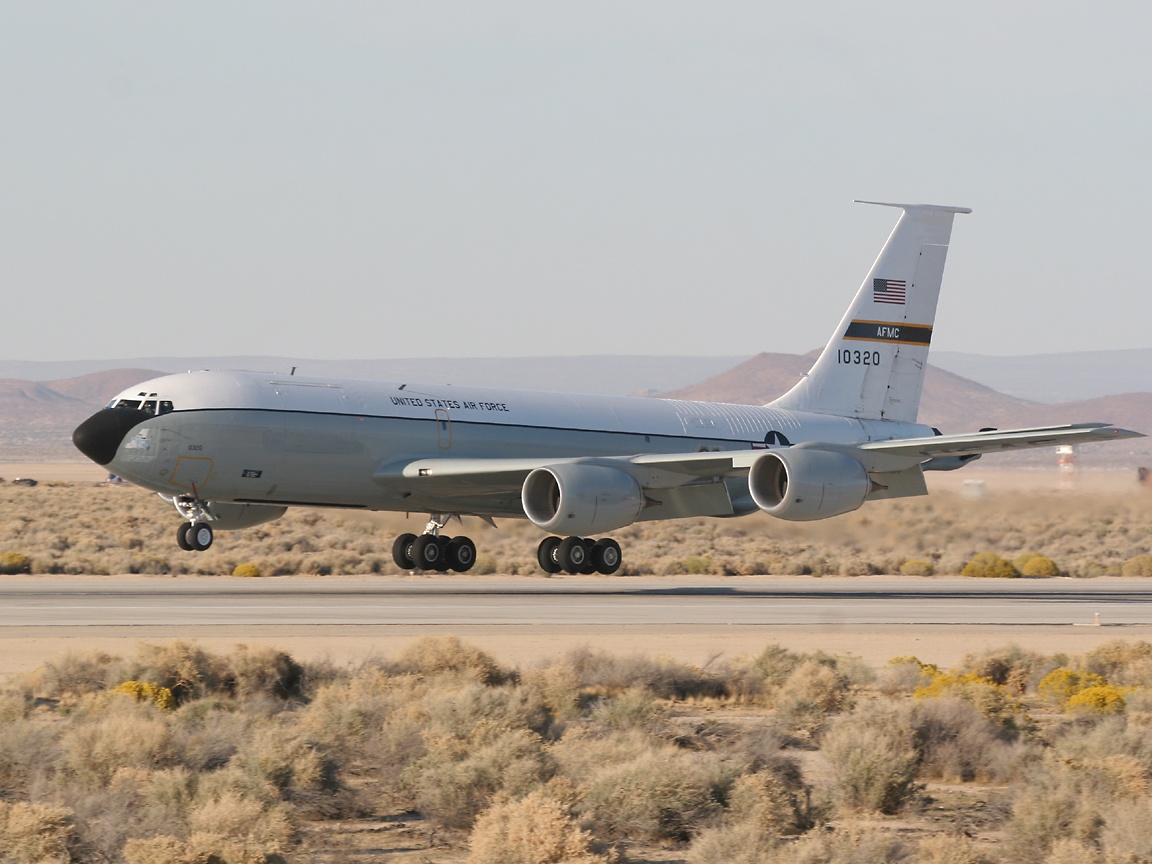
KC-135 Stratotanker aerial refuelling tanker is much older than the Globemaster
III,
in fact it was a parallel development with Boeing's first jet airliner,
the Dash 80, also known as the
Boeing 707. Almost all Boeing
707s have been retired, movie star
John Travolta flies one of the last
ones still operating in the United States, but the
KC-135 is still going
strong and re-engined examples like this one will continue in service for
a lot longer.
|
 |
| Add caption |
|
Edwards
is an excellent place to see a wide variety of modern
American military
aircraft flying, and this year there was a special treat, an
F-16 Fighting
Falcon jet fighter based at Edwards, but flown by pilot
Gert-Jan Vooren
of the Royal Netherlands Air Force.
His call sign is "Goofy",
but his display is anything but Goofy!
In fact, the Royal Netherlands
Air Force F-16 display is widely considered to be the best demonstration
by this aircraft type anywhere in the world.
It's very loud,
very aerobatic, stays very close to the crowd and is greatly enhanced by
the use of flares and the
"smokewinder" smoke generators you can see in
action here.
Sadly, the flares weren't on show at Edwards,
perhaps out of fear that they might set the desert scrub on fire,
but the
rest of the display was as superb as ever, and several people said they
felt sorry for the
US Air Force F-16 pilot who had to follow this act with
his own less spectacular routine.
I don't have a full presentation
of the
Dutch display on this website, but there
is a
computer wallpaper of it doing its full display at the
2002 Royal International
Air Tattoo in England.
|
 |
Here's
the USAF's most exciting new aircraft, the
F-22 Raptor air superiority fighter.
This is a replacement
for the ageing F-15 Eagle, which is still considered by most people to
be the world's best fighter aircraft.
The Raptor has significant
advantages over the Eagle, including the ability to
"supercruise" at about
Mach 1.5 without using its afterburners, and the same type of stealth technology
already employed on the
F-117 Nighthawk and the B-2 Spirit.
You shouldn't be too surprised to hear that both the F-15 and the F-22
made their first flights at Edwards, the
F-15 on July 27, 1972 and the
YF-22 on September 29, 1990. Oh, and the B-2 made its maiden
flight here on July 17, 1989!
|
 |
Not
only are interesting aircraft types on display at Edwards,
but the displays
tend to be more interesting than at other shows,
perhaps partially because
this is the air force's test center and also
because there's an awful lot
of empty space here, with little danger of damage on the ground in
the
extremely unlikely event that something goes wrong.
As an example,
Edwards is probably the only show anywhere where you'll see a pass by a
Raptor with all of its weapons bays open.
Officially, the Raptor
is designated the
F/A-22 Raptor to signify that it has abilities both as
a fighter and as an attack aircraft able to bomb ground targets.
In practice this is a claim forced on the military and its contractors
by
politicians wanting to make a name for themselves as defenders of the
public purse - the Raptor was designed as a
pure air-to-air fighter aircraft,
and while it is able to carry a small quantity of bombs within these bays,
its
capacity is far lower than less high performance but more versatile
aircraft like the F/A-18 Hornet.
To carry more ordnance the
Raptor has to use external bomb racks
which almost completely obliterate
the aircraft's stealthy characteristics, as well as affecting its ability
to supercruise.
|
 |
Like
the Stratotanker, the B-52 Stratofortress was designed by Boeing and entered
service in the mid
1950s, and like the Stratotanker it has a surprisingly
bright future. Continually updated since they were
first introduced,
these two dinosaurs are expected to remain in service for several more
decades.
|

|
Although
the B-52 frequently appears at airshows as a static exhibit, it's not too
often that members of
the public get to see a full display, taking off,
doing multiple passes and landing at the same place.
Not only
did this demonstration include separate passes with landing gear down and
bomb bays
open, but after one pass they also did this rapid climb out,
which I've never seen before.
It certainly gives a different
perspective on the Stratofortresses massive 185 foot (56.5 meter) wingspan.
|
 |
The
B-1B Lancer looks like it should have made the B-52 totally obsolete, and
on paper it
certainly looks like a worthy successor, able to carry almost
135,000 pounds (61 tonnes)
of ordnance compared to the B-52's 70,000 pounds
(32 tonnes),
and able to fly at Mach 1.2 against the B-52's top speed of
Mach 0.86.
The Lancer also has a much lower radar signature
and far better electronics.
|

|
 The B-1 might be far more technologically advanced than the B-52, but it
has an even more sophisticated counterpart in the B-2 Spirit, which is
popularly called the "stealth bomber". The B-2 demonstration
at Edwards is far better than the one put on at other airshows, so I've
put together an entire page about the
stealth bomber display at the 2005 Edwards AFB airshow.
The B-1 might be far more technologically advanced than the B-52, but it
has an even more sophisticated counterpart in the B-2 Spirit, which is
popularly called the "stealth bomber". The B-2 demonstration
at Edwards is far better than the one put on at other airshows, so I've
put together an entire page about the
stealth bomber display at the 2005 Edwards AFB airshow.
This crazy looking aircraft was designed to penetrate heavily defended
territory which would be too dangerous for the B-1 or B-52, however some
critics say that since the collapse of the Soviet Union it no longer has
a credible opponent (a charge which is also levelled against the F-22 Raptor).
It has almost exactly the same maximum speed as the B-52, but can only
carry 40,000 pounds (18 tonnes) of ordnance compared to the B-52's 70,000
pounds or the B-1's 135,000 pounds.
|
Completing the lineup of America's front-line aviation weaponry is this
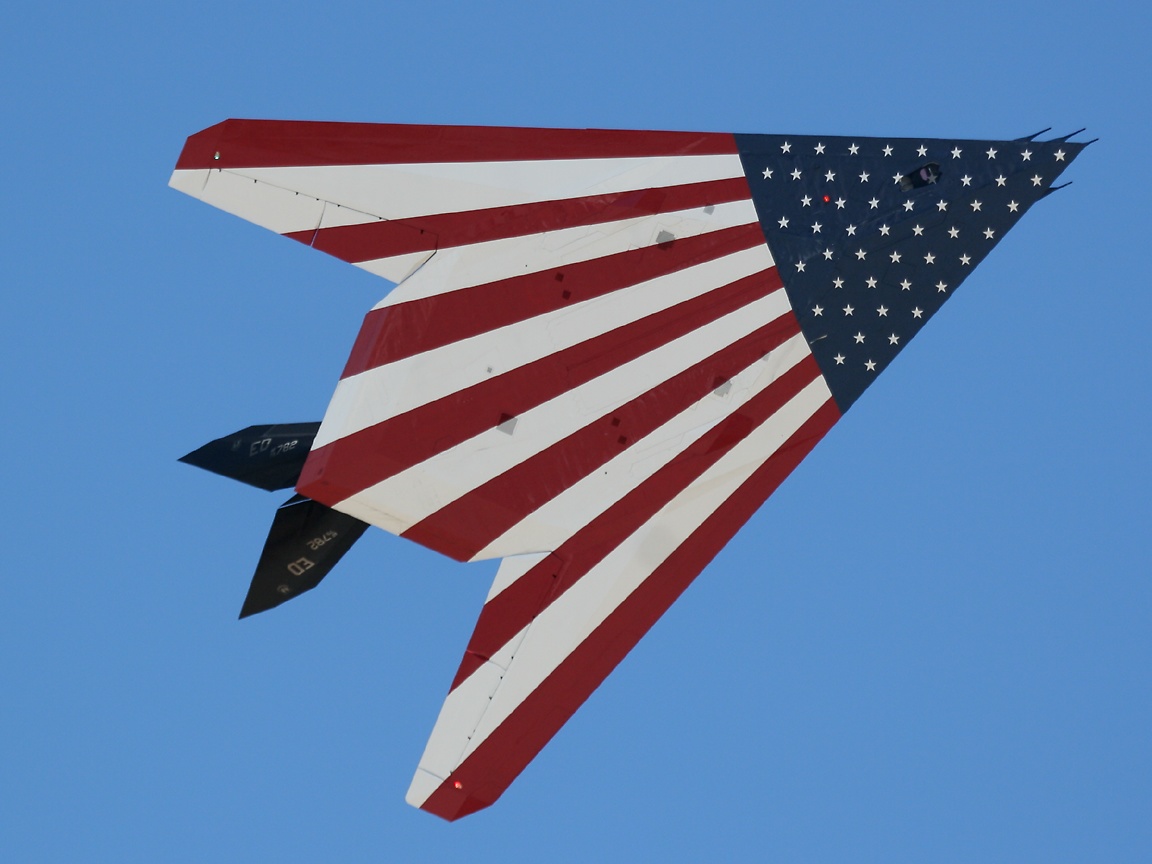
F-117 Nighthawk, commonly known as
the "stealth fighter". It
would actually be more accurate to say that this is a YF-117A Nighthawk,
since this is
the third prototype aircraft. This same aircraft
was painted up in this US flag scheme in 1983, but since the
Nighthawk
was still a top secret project at that time, very few people ever saw it;
however because
this aircraft was due to be retired straight after this
show, it was decided to paint it up again and put it on
public display
in this scheme for the first time ever.
Just to say it again, this is the sort of display that makes the Edwards
show so special - it's the only event in
the world where you have any hope
of seeing an F-117, a B-1, B-2, B-52 and F-22 all put on extended
performances
in the same place at the same time.
|
 |
But
wait, there's more! Since many of the aircraft at Edwards are
test planes rather than combat aircraft,
you'll also see paint schemes
which are found nowhere else, like this very graceful T-38 Talon supersonic
trainer,
which is used as a chase plane to follow aircraft undergoing flight
testing.
This white scheme isn't one you'll see in too many
other places.
|
 |
|
Nor
is the white-and-orange scheme on this two-seater F-16 Fighting Falcon
likely to turn up in too many places!
|
 |
As
I mentioned earlier, NASA also has its Dryden Flight Research Center at
Edwards, so not only can you see interesting
NASA color schemes, but you
can see some unusual NASA aircraft as well. Several were on
static display, and
they also flew one of their F-18 Hornet chase planes
(which was itself chased by a NASA T-34 Mentor),
as well as some real oddities,
like this highly modified F-15 Eagle code named ACTIVE,
which not only
has large auxiliary canard wings near the front, but also has thrust vectoring
engines like on several
of the
Russian fighter aircraft which displayed at the 2005 MAKS airshow
in Moscow.
The ACTIVE F-15 also has an "intelligent flight
control system" which consists of an adaptive neural network
which is intended
to allow the aircraft to continue to fly even after it suffers serious
damage in
flight which would otherwise cause the plane to crash.
It has to be said that the F-15 is already able to survive a great deal
of damage and keep flying even
without a computerized neural network -
an Israeli air force
F-15 had a mid-air collision with an Israeli A-4 Skyhawk,
but the pilot was able to bring the
Eagle in for a safe landing even though
it had lost nearly its entire right wing!
|
 |
Here's
another interesting and unusual NASA aircraft, an ER-2 high-altitude research
plane,
which was derived from the U-2 spy plane. This shot
of it taxying towards the crowd area after
performing its demonstration
shows off its glider-like wingspan of over 103 feet (33 meters).
The aircraft has a bicycle landing gear with two sets of wheels mounted
fore and aft under the fuselage,
so before liftoff and after landing a
support truck trails it, to retrieve and later refit the flimsy
"pogo stick"
landing gears which you can see about half-way along each wing.
These wheels fall off automatically at takeoff, but are put back on after
the pilot slows
the plane to a crawl and allows one wing to dip towards
the runway.
All of this happened during the show, and I was
also lucky enough to see
the same thing about 10 years ago when I was still
living in New Zealand, where NASA was doing ozone hole research.
|
 |
Another
speciality of the Edwards show is the mass flyby done by many different
air force aircraft types.
This year the display consisted of
a C-12 Huron, B-2 Spirit, KC-135 Stratotanker,
MC-130 Hercules, C-17 Globemaster
III, B-52 Stratofortress, the American flag F-117 Nighthawk,
F-16 Fighting
Falcon, T-38 Talon, the F-16 Fighting Falcon in the white and orange color
scheme which you saw earlier on this page, and the F-22 Raptor.
It's a really spectacular display.
|
 |
The
mass flyby is an awesome sight, but it's very difficult to take a photograph
which does it justice - you just have to be there to experience it!
Highlights of the 2005 Nellis AFB "Aviation Nation" Airshow
The theme of this year's show was "Welcoming Home Our Vietnam Veterans" and
an excellent collection of
Vietnam aircraft was put together, better even
than the similarly-theme Selfridge
ANGB airshow earlier in the year.
Leading the way was a flight
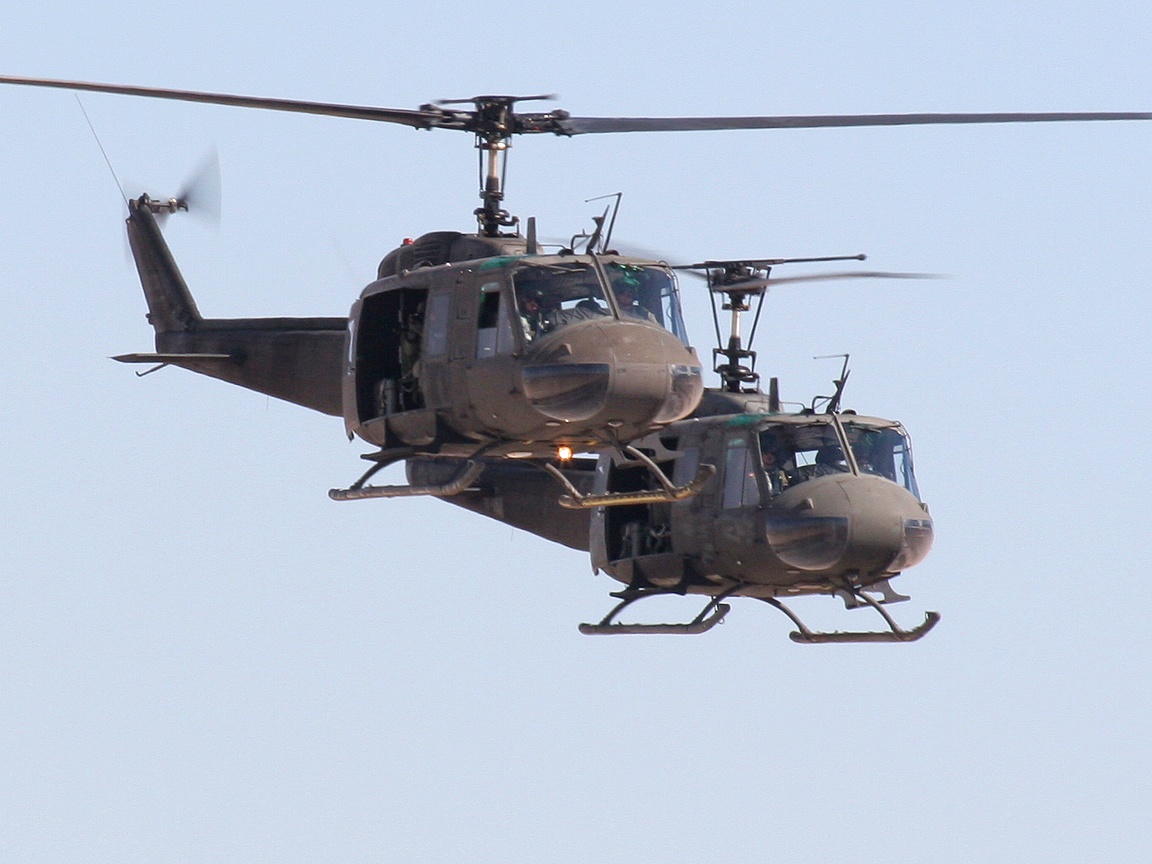
of iconic aircraft from the Vietnam conflict, the ubiquitous UH-1 Iroquois,
better known as the "Huey".
Three Hueys thudded their way past
the crowd line each day, including these two in close formation.
|

|

The iconic fixed wing aircraft of Vietnam was probably the F-4 Phantom II,
which flew with the air force, navy and marines.
This particular
aircraft is a QF-4 Phantom II drone used as a target for missile testing,
nicely painted up by the air force in a
South-East Asia color scheme.
The Collings Foundation operates an
F-4D Phantom II in Vietnam colors,
and I was fortunate enough to do an
air-to-air photo shoot of the
Collings F-4 earlier this year.
|
 |
This OV-10 Bronco is far less well known than the Huey or the Phantom.
It was the first
American aircraft specifically designed for the forward
air controller and observation roles; prior to this time conversions
of
civilian aircraft like the O-1 Bird Dog and O-2 Skymaster were used in
Vietnam.
The Bronco was far more capable than either the Bird
Dog or Skymaster, with higher speed, better
protection for the pilots and
greater firepower like the machine guns you can see here sticking out of
the sponsons under the fuselage.
It's very rare to see one
at an airshow, so it was nice to see this aircraft registered just last
year by the Cactus Air Force here in Nevada.
|

|
The Douglas Skyraider is a much more commonly seen aircraft on the airshow
circuit, at least in its navy or marine incarnations.
The Skyraider
first flew during world war two, but its heavy load capacity and long loiter
time made it ideal for later conflicts,
and it was used a great deal during
the Vietnam war. Here you see the one-man marine corps
AD-4N
version, and the seldom seen four-man A-1E used by the air force.
|
 |
This particular A-1E is one of the mostly nicely restored Skyraiders in operation,
the simulated ordnance provides a lot of extra interest,
specially during
the type of simulated bombing combat mission which was provided at the
show by
Chris Rainey and the rest of his pyrotechnic crew.
|

|
The Cessna aircraft corporation was responsible for the Bird Dog and Skymaster,
but they also produced a few aircraft
designed especially for the military,
like this A-37 Dragonfly. Developed from the T-37 Tweet trainer,
the
A-37 performed ground attack work using the six-barrelled GAU-2B mini-gun
which you can see extending from the top
of the nose. Like
the Skyraider, the Dragonfly can also carry an extraordinary load of munitions
under its wings, which is
part of the reason why it's still in service
with several South American air forces.
|
 |
You might think that this plane doesn't belong in a Vietnam war remembrance,
but in fact this AC-47 gunship,
commonly referred to as "Spooky" or "Puff
the Magic Dragon", is very familiar to people who know about this conflict.
Basically a world war two vintage C-47 Skytrain transport armed with 3
miniguns, these
gunships could pour an enormous amount of firepower onto
ground targets, usually Viet Cong forces besieging a military base or village.
|
 |
Because of the theme of this year's show, the pre-Vietnam warbird lineup was emphasized
less than in previous years,
as was the simulated Reno Air Race which is
held each year; nevertheless there was still plenty on offer for aerobatic
fans and those interested in military aircraft from other eras.
|
 |
This B-25 Mitchell bomber was one of the world war two aircraft which flew on
the day, together with the
P-51 Mustangs "Six Shooter" and "Val Halla".
|
 |
There was also plenty of entertainment for people who need their fix of modern
military aircraft turning and burning,
with spirited demonstrations like
this one by an F-15 Eagle, as well as a display by its counterpart the
F-16 Fighting Falcon.
|

|
|
The Eagle put on a great display, including this knife-edge pass while in full
afterburner.
|
 |
The Eagle was very good, but the air force's latest air superiority fighter
definitely stole this section of the show.
The F-22 Raptor
flew at last
year's Nellis airshow, but restricted its display to high flat passes
and steep climbs far from
the crowd area. It seemed that the
air force might be following the policy pioneered by the
F-117 Nighthawk
"stealth fighter" and B-2 Spirit "stealth bomber", only doing tame routines
with these extremely expensive aircraft in order to reduce the risk of
bad publicity in the event of an accident.
|

|
 Thankfully, this year's display at Nellis threw this type of caution to the wind with
an excellent display of low takeoff passes, steep afterburner climbs and
banked passes also with afterburner.
Thankfully, this year's display at Nellis threw this type of caution to the wind with
an excellent display of low takeoff passes, steep afterburner climbs and
banked passes also with afterburner.
It's the type of performance which ardent aircraft fans hope will get better and better
as this extraordinarily capable aircraft settles into regular service.
|
The airshow community can be thankful that the top brass also allowed the Raptor
to participate in the air force's
Heritage Flight program, pairing today's
top of the line hardware with their equivalents from earlier times, like
this world war two
P-51 Mustang.
|
 |
Since this show had a Vietnam theme, it was extremely appropriate that fighters
from three generations should be
flown together.
|

|
There was one other Vietnam era plane which flew at the show, a Russian designed
MiG-17 "Fresco" as flown by the
North Vietnamese air force.
It's great to see aircraft like this flying, though for purists like myself
it's maybe not so
good to see them plastered over with capitalist advertising!
Of course the great majority of the audience doesn't care
about details
like that, and the owner and pilot, Bill Reesman, does an excellent display,
as you might expect from
someone who flew 320 combat missions in Vietnam
flying the F-100 Super Sabre.
|
 |
Chris Rounds also does a good display in his sponsored T-33 Shooting Star trainer,
named The Red Knight after a
Royal Canadian Air Force T-33 display aircraft
which flew demonstrations for many years in the same colors.
|
 |
There were no Canadians flying at this show, but the USAF Thunderbirds display
team is based at
Nellis air force base and always does its end of the year
homecoming performance at the show.
This year's show included
a surprising number of overflights of the crowdline by solo pilots, but
the crowd loved
the demonstration of what these aircraft can do.
|
 |
A performance of another kind took place in the late afternoon light - the
first ever display at an airshow by the
Predator unmanned aerial combat
vehicle, complete with pyrotechnics as the Predator did a simulated attack
run
using the inert hellfire missiles carried under its wings.
In real life the Predator was first used in this way in
Afghanistan in
2001 and again in Yemen in 2002. Nellis is one of the main
centers for flying
UCAVs, so it was very appropriate that there were several
different models on static display.
|

|
Before and after the flying there was plenty of time to browse the huge static
display of aircraft spread across
the show grounds. This year's
display was up to the usual high standard, with highlights including
this
restored 1930s Dornier Do-24 flying boat complete with modern turbo-prop
engines, the historic C-141 Starlifter
"Hanoi Taxi" used to evacuate POWs
from Hanoi at the end of America's involvement in that war, and an
EP-3
AWACS plane. There was a sad looking MiG-29 "Fulcrum" jet fighter
near the entrance, sister ship to the
pristine
MiG-29 in the Threat Training Facility at Nellis; the folks
from the TTF had a variety of hardware on display, including a scud missile.
|
 |
As always, many of the most interesting aircraft stayed on static display
and only flew when arriving and departing.
I wasn't there for
the main arrival and departure days, but several aircraft did sneak out
on Sunday after almost
everyone had left, including this great looking
Grumman Albatross flying boat, which made its exit as the last of the day's
sunlight vanished.
|
 |
See the highlights of the Nellis AFB "Aviation Nation" Airshow in 2004,
2006,
2007
and 2009.


 After the initial preemptive strike, PAF adopted a defensive stance in response to the Indian retaliation. As the war progressed, the Indian Air Force continued to battle the PAF over conflict zones[40], but the number of sorties flown by the PAF gradually decreased day-by-day.[41] The Indian Air Force flew 4,000 sorties while its counterpart, the PAF offered little in retaliation, partly because of the paucity of non-Bengali technical personnel.[4] This lack of retaliation has also been attributed to the deliberate decision of the PAF High Command to cut its losses as it had already incurred huge losses in the conflict.[42] The PAF also did not intervene during the Indian Navy's raid on Pakistani naval port city of Karachi.
 Lieutenant General Jagjit Singh Aurora, who commanded the eighth, twenty-third, and fifty-seventh divisions, led the Indian thrust into East Pakistan. As these forces attacked Pakistani formations, the Indian Air Force rapidly destroyed the small air contingent in East Pakistan and put the Dhaka airfield out of commission. In the meantime, the Indian Navy effectively blockaded East Pakistan.